The first years of school are about much more than learning letters and numbers. They are about helping children discover how to learn, how to communicate, how to make friends, how to express themselves, and how to approach the world with confidence and curiosity.
For families considering a British curriculum school in Dubai, Foundation Stage 1 can be an especially important starting point. At Glendale International School, FS1 is designed for children aged 3–4 and follows the British Early Years Foundation Stage (EYFS) approach. Learning combines child-initiated exploration with purposeful adult-led experiences, creating a balance between independence, play, relationships and structured learning.
But what makes FS1 such a powerful beginning to the British curriculum?
The answer lies in the seven areas of learning and development that work together to build the foundations children need for the years ahead.
What is FS1 in the British curriculum?
Foundation Stage 1 is an early years stage typically designed for children around three to four years old. It introduces children to school through an age-appropriate learning environment where play, exploration, communication and relationships are central to development.
Rather than expecting young children to sit still and absorb information for long periods, the EYFS approach recognises that children learn through meaningful experiences, interactions and play. The seven areas of learning provide a framework for developing the whole child, rather than focusing solely on academic skills.
At Glendale, this approach is reflected in a Foundation Stage environment that combines structured activities with child-led exploration. The school describes its approach as experiential, with learning designed to help children develop deeper understanding rather than simply memorising facts and figures.
Why is FS1 important for a child’s education?
FS1 can help children make the transition from home or nursery into school life gradually and confidently.
At this age, children are developing rapidly across language, movement, emotional regulation, social interaction, thinking and creativity. A strong early-years programme therefore needs to nurture these areas together.
The EYFS framework identifies three prime areas—Communication and Language, Physical Development, and Personal, Social and Emotional Development—which provide the foundations for learning. Four specific areas—Literacy, Mathematics, Understanding the World, and Expressive Arts and Design—then help children apply and extend these foundational abilities.
This interconnected approach is one reason FS1 can be such a meaningful introduction to the British curriculum.
What are the seven areas of learning in EYFS?
The seven EYFS areas of learning are:
- Communication and Language
- Physical Development
- Personal, Social and Emotional Development
- Literacy
- Mathematics
- Understanding the World
- Expressive Arts and Design
The first three are known as the prime areas, while the remaining four are the specific areas. Importantly, these areas are not isolated subjects. They overlap naturally throughout a child’s day.
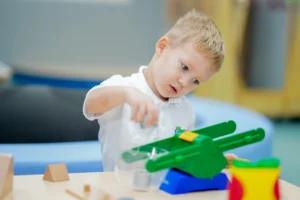
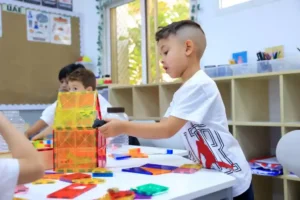
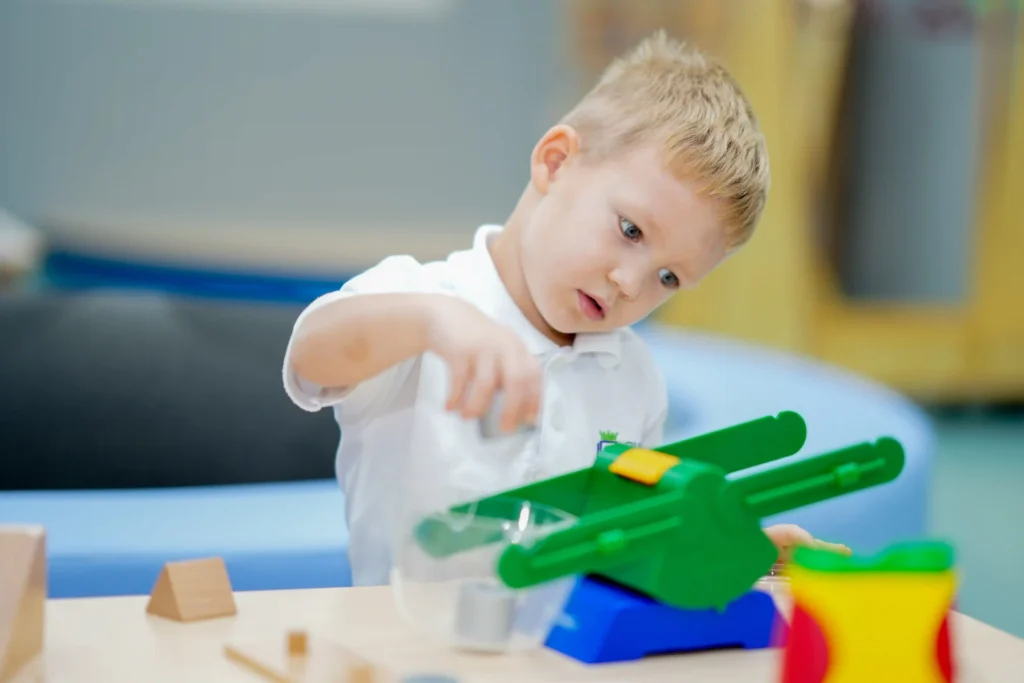
A child building a model, for example, may be developing physical coordination, communicating ideas, solving mathematical problems, working with another child and using creativity—all within one experience.
That is the strength of a well-designed early-years curriculum: one experience can support many dimensions of development at once.
How does Communication and Language help children in FS1?
Communication is at the heart of early learning.
In FS1, children are encouraged to listen, speak, ask questions, share ideas, develop vocabulary and participate in conversations. Stories, songs, role play, discussions and everyday classroom interactions can all create opportunities for children to communicate.
The importance of this area extends far beyond speaking. The UK Department for Education states that spoken language underpins all seven areas of learning and that high-quality interactions contribute to language and cognitive development.
At Glendale, speaking and listening are emphasised as essential skills that support children’s development across the seven areas.
This means that when a child confidently explains an idea, listens to a story or asks a thoughtful question, they are developing skills that can support future literacy, relationships and academic learning.
How does Physical Development prepare children for school?
Learning begins with the body as well as the mind. Physical Development helps children develop coordination, movement, balance and control while also encouraging independence in everyday routines.
In an FS1 environment, this might involve outdoor play, movement activities, construction, drawing, manipulating objects or learning to manage personal routines.
These experiences can help children become more confident in navigating their environment and using the physical skills needed for future classroom activities.
At Glendale, children are encouraged to engage in varied movement experiences designed to build agility, coordination and confidence.
Why is Personal, Social and Emotional Development important in FS1?
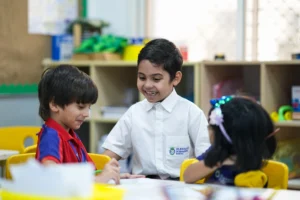
Starting school is an emotional milestone. Children are not simply learning how to read or count; they are learning how to enter a new environment, build relationships, manage feelings, become increasingly independent and participate in a community.
Personal, Social and Emotional Development supports these essential foundations. The EYFS guidance highlights the importance of relationships, emotional development, confidence, self-regulation, independence and positive relationships with others.
At Glendale, PSED is placed at the heart of the Foundation Stage, with a focus on helping children develop independence, resilience, kindness, confidence and a sense of belonging.
A child who feels secure and valued is better positioned to participate, explore, ask questions and take on new challenges.
How does FS1 build early literacy skills?
Literacy in FS1 is about developing the foundations of reading and writing while nurturing a genuine enjoyment of language.
Children can encounter books, stories, sounds, rhymes, mark-making, imaginative play and conversations in ways that make literacy meaningful rather than simply instructional.
At Glendale, the Foundation Stage includes interactive reading, storytelling and creative writing experiences designed to nurture a love of reading and writing.
The goal is not simply to produce children who can recognise letters. It is to encourage children to see books, stories, words and communication as exciting ways of understanding and expressing the world.
How does Mathematics in FS1 prepare children for future learning?
Early mathematics begins with curiosity. Counting objects, recognising patterns, comparing quantities, exploring shapes and solving simple problems help children begin to understand mathematical relationships.
In FS1, mathematics can be embedded into everyday experiences rather than treated as something that exists only on a worksheet.
At Glendale, hands-on activities include playful counting, basic mathematical concepts and problem-solving experiences that help children connect early numeracy with real situations.
These experiences establish early mathematical thinking that can be built upon throughout the British curriculum.
This is where learning becomes particularly powerful: children are not simply receiving information. They are beginning to investigate their world.
Why are Expressive Arts and Design important in FS1?
Creativity gives children another language through which to communicate.
Through music, movement, art, role play, design and imaginative experiences, children can explore ideas and emotions while developing creativity and confidence.
Expressive Arts and Design also creates opportunities for children to make choices, experiment and discover that there can be different ways to approach a problem.
At Glendale, creativity forms part of the school’s wider enriched British curriculum, with the Foundation Stage designed around meaningful, experiential learning.
How do the seven areas of learning work together?
The most important thing to understand about the EYFS is that the seven areas are connected. A single activity can develop several areas simultaneously.
Imagine children creating a pretend grocery shop.
They might:
- Talk to classmates and learn new vocabulary — Communication and Language
- Count items and compare quantities — Mathematics
- Make signs and explore sounds and letters — Literacy
- Take turns, cooperate and negotiate roles — Personal, Social and Emotional Development
- Move around the environment and handle objects — Physical Development
- Learn about food, people and everyday life — Understanding the World
- Use imagination and role play — Expressive Arts and Design
This is why the seven areas provide such a strong foundation. They help children develop the academic, physical, social, emotional and creative capabilities that future learning depends upon.
The EYFS framework specifically recognises that the prime areas are strengthened and applied through the four specific areas.
Why is play-based learning important in FS1?
For young children, play is not separate from learning. It is one of the principal ways they explore ideas, practise skills, communicate and make sense of their experiences.
The EYFS framework states that children are mostly taught through games and play.
At Glendale, this philosophy is reflected in a balance of child-initiated and adult-led experiences. The school describes its Foundation Stage as a place where purposeful play, exploration, routines and intentional teaching work together.
How does FS1 prepare children for FS2 and primary school?
A strong FS1 experience is not about rushing children towards formal academics. It is about developing the underlying skills that make future learning possible.
Children begin building:
- Confidence in communicating with others
- Independence and self-care skills
- Listening and attention skills
- Early literacy and numeracy understanding
- Physical coordination
- Social skills and relationships
- Curiosity and problem-solving
- Creativity and self-expression
- Positive attitudes towards learning
These foundations can make the transition into later stages of the British curriculum more natural.
Glendale’s curriculum continues from Foundation Stage into the National Curriculum for England, with students moving into primary education where subjects such as English, Mathematics, Science and ICT form part of the curriculum alongside UAE-specific requirements and other specialist subjects.
The perfect foundation starts with the whole child
The beauty of FS1 is that it does not ask children to choose between learning and play, academics and creativity, independence and support. It brings these elements together.
Through the seven areas of learning, children begin developing the language to express their ideas, the confidence to build relationships, the physical skills to explore, the literacy and mathematical foundations to understand symbols and quantities, the curiosity to investigate their world, and the creativity to imagine what might be possible.
That is what makes FS1 such a meaningful beginning to the British curriculum.
At Glendale International School, the journey starts with a simple but powerful idea: when children feel safe, valued and inspired, they are ready to learn.
And when the foundations are strong, every stage that follows has something solid to build upon.
Frequently Asked Questions
1. What age is FS1 in the British curriculum?
FS1 at Glendale International School is designed for children aged 3–4 years. It forms part of the school’s Foundation Stage, alongside FS2 for children aged 4–5.
2. What does FS1 mean in a British school?
FS1 means Foundation Stage 1. It is an early-years stage that introduces young children to school through developmentally appropriate experiences based on the British Early Years Foundation Stage approach.
3. What are the seven areas of learning in FS1?
The seven areas are Communication and Language; Physical Development; Personal, Social and Emotional Development; Literacy; Mathematics; Understanding the World; and Expressive Arts and Design.
4. What are the three prime areas of EYFS?
The three prime areas are Communication and Language, Physical Development, and Personal, Social and Emotional Development. These provide important foundations for learning and development.
5. What are the four specific areas of EYFS?
The four specific areas are Literacy, Mathematics, Understanding the World, and Expressive Arts andDesign. They help children strengthen and apply the skills developed through the prime areas.
6. Does FS1 teach reading and writing?
FS1 introduces children to the foundations of literacy through experiences such as stories, reading, communication, mark-making, sounds and creative activities. The emphasis is on developing the skills and enjoyment that support future literacy.
7. How does FS1 prepare children for primary school?
FS1 helps children develop foundational skills in communication, independence, physical development, social interaction, early literacy, mathematics, creativity and understanding the world. These skills provide a platform for future learning across the British curriculum.