
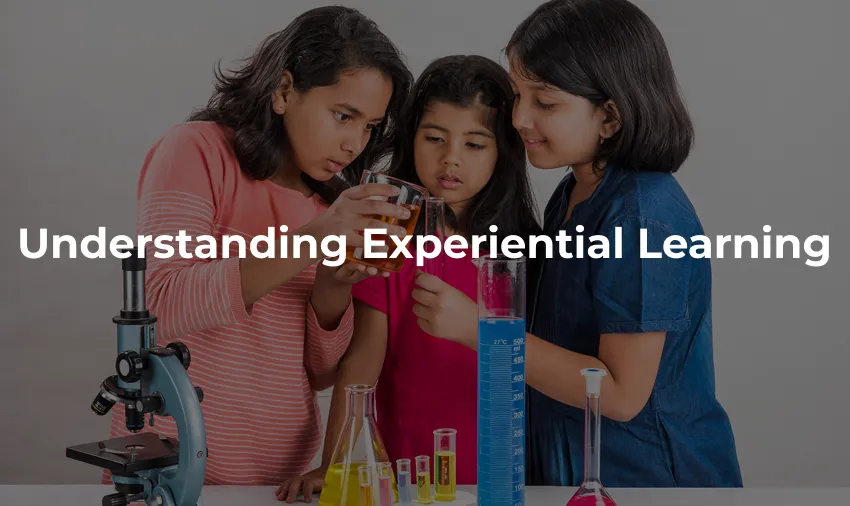
Today, as the world demands innovation, adaptability and critical thinking, traditional classroom methods alone are no longer sufficient. Learners need real-life experiences that foster deep understanding and meaningful growth. This is where the experiential learning method steps in.
Experiential learning theory is not a new concept, but it is now gaining attention. As educators seek to make learning more relevant and impactful, experiential learning is now a part of many schools in Hyderabad. The method places learners at the center of the learning process and involves them with hands-on experience.
Experiential learning transforms passive education into an active journey of discovery. Let us explore more about the theory of experiential learning with its benefits and applications.
What is Experiential Learning?
Before getting into any details, it is important to understand what is experiential learning. It is a process through which learners gain knowledge and skills by engaging directly in meaningful experiences. Instead of just simply absorbing information, students apply concepts in real-life situations, reflect on those experiences and use the insights to deepen their understanding.
Experiential learning is often associated with educational theorist David Kolb, who outlines the term into 4-stages:
- Concrete Experience – Doing or having experience
- Reflective Observation – Reflecting on the experience
- Abstract Conceptualisation – Learning from the experience and forming new ideas
- Active Experimentation – Applying what was learned in various new situations
This cycle clearly illustrates how effective learning is an ongoing process and is fueled by doing, thinking and applying.
The Educational Philosophy Behind Experiential Learning
-
Constructivism
This theory highlights that learners construct their own understanding through his/her own experiences and reflection. Learning is not simply transferred from teacher to student but built internally through exploration and inquiry.
-
Progressivism
This theory focuses on learning by doing, critical thinking and student engagement. It ensures that education should prepare students for life by immersing them in real-world situations.
-
Humanism
Humanistic education focuses on personal growth and self-directed learning. The various experiential learning activities that perfectly reflect this approach empower students to take ownership of their learning. Students are also encouraged to explore topics that resonate with them.
These philosophical understandings make experiential learning a holistic and student-centric approach. It promotes not just academic achievements but also emotional and social development as well.
Key Benefits of Experiential Learning
There are various benefits of experiential learning for students, educators and the learning environment as a whole.
-
Deeper Understanding and Retention
Students retain more information when they are involved actively with content. Moreover, they feel motivated to apply the learned knowledge in real-world situations to gain confidence and self-esteem.
-
Development of Critical Thinking and Problem-Solving Skills
Experiential learning encourages learners to analyse, evaluate and make informed decisions. Students learn to think critically to easily navigate challenges.
-
Improved Engagement and Motivation
Students feel motivated when they learn with hands-on, relevant and dynamic experiences. Experiential activities spark curiosity and give learners a sense of ownership and purpose.
-
Collaboration and Communication
Many experiential learning activities involve teamwork. This promotes collaboration, leadership and interpersonal communication; the skills that are essential for success in the modern world.
-
Personal Growth and Emotional Intelligence
Reflection, a core component to understand the meaning of experiential learning, fosters empathy, self-awareness and resilience. Students learn to accept feedback, deal with failures and develop a growth mindset.
-
Preparation for Real Situations
Experiential learning reduces the gap between academic theory and practical application. Students gain skills, values and confidence that translate directly to their college, careers and civic life.
Classroom Applications of Experiential Learning
Implementing modern examples of experiential learning doesn’t require a complete curriculum overhaul. It can be done in practical and effective ways.
-
Project Based Learning
Students learn by working on real-world problems or challenges over an extended period. They investigate, plan and create tangible solutions by using knowledge and practical skills.
-
Service Learning
This combines community service with academic goals. Top schools encourage students to use knowledge learned in the international baccalaureate programme to address local needs.
-
Educational Tours
Taking learning beyond the classroom helps students connect theory to practice. This provides rich and immersive experiences to the students.
-
Simulations and Role-Playing
Students take on roles and navigate simulated real-life scenarios to promote empathy, decision-making and critical analysis.
-
Outdoor and Environmental Education
Outdoor experiences cultivate environmental awareness and hands-on science learning.
Challenges and Considerations
While the importance of learning through experience has many benefits, there are also some challenges.
- Time constraints within rigid curricula
- Assessment difficulties in measuring soft skills and informal learning
- Resource limitations for outdoor learning
However, these challenges are addressed through collaboration and gradual integration of experiential learning into existing frameworks.
Conclusion
Experiential learning redefines education as an active, reflective and personalised journey in the Cambridge international school Hyderabad. By engaging students in meaningful experiences, it transforms learning from a passive activity into a powerful force of growth.
It also encourages students to learn more than just memorising facts. It enables them to think critically, adapt, collaborate and lead. Experiential learning makes education more relevant, engaging and human. The experiences we offer students today will shape the leaders of tomorrow!