
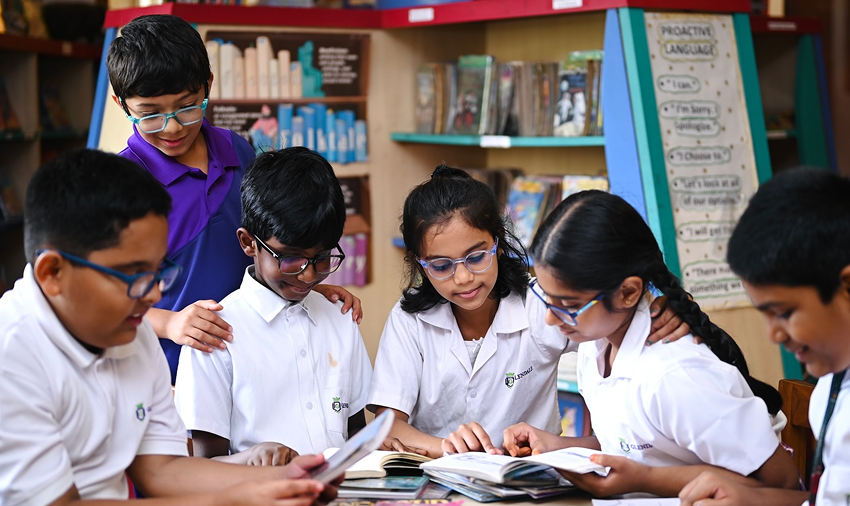
Supporting students to improve their reading skills is important as it helps to build comprehension, imagination, and a lifelong love for learning. When children feel confident in their ability to read, they are more likely to succeed across all academic subjects and develop skills.
In the primary years, when children are at the most formative stage of development, the ability to read well impacts every subject they encounter.
Parents and teachers often wonder: How can we improve reading skills in students so they don’t just read, but truly understand and enjoy what they read?
At Glendale International Schools, one of the best primary schools in Hyderabad, we are committed to helping students enhance their reading skills so they can excel academically, socially, and emotionally.
In this guide, we will show you some practical strategies on how to develop reading skills in students and enjoy reading. You can be sure that these strategies are effective, and we are here to support you at every step.
Building a Foundation: The Love for Reading
Before a child can master the mechanics of reading, they must first develop a genuine passion for it. A child who loves reading will be motivated to practice and improve.
- Read Aloud Regularly: Reading aloud on a regular basis should be a daily activity. Pick a calm time, such as before bed or in the afternoon. This helps kids pick up new words and ways to form sentences, as well as understand how language flows. Even after they learn to read on their own, reading aloud can keep the activity enjoyable and help create moments you can share.
- Create a Reading Nook: Create a cosy reading space in your home stocked with diverse books, from picture books to graphic novels and non-fiction, offering your child choices.
- Be a Reading Role Model: Let your child see you enjoying books and talking about what you’re reading, sharing your enthusiasm. When they observe reading as valuable and fun, they’re more likely to adopt that mindset.
Decoding the Text: Phonics and Word Recognition
Phonics is a way to teach children how to link sounds to letters or groups of letters. When children master phonics, they can decode new words on their own, and it is one of the crucial steps in improving reading skills in students.
- Practice Phonics: Use fun games and activities to practice phonics. You can use flashcards, rhyming games, or even magnetic letters on the fridge to help them recognise letter-sound relationships.
- Introduce Sight Words: Sight words are common words that don’t always follow standard phonetic rules (e.g., “the,” “said,” “are”). Encouraging your child to memorise these words helps them read more fluently and reduces frustration. You can use simple games to make learning them enjoyable.
- Use Context Clues: Teach your child to use pictures and the surrounding words to figure out the meaning of a new word. This strategy helps them build vocabulary and become more independent readers.
Understanding the Power of Comprehension in Story
Reading comprehension is a reader’s ability to understand the explicit and implicit meaning of text. It helps students to turn words into thoughts and ideas.
- Ask Open-Ended Questions: After reading a story together, ask questions that require more than a “yes” or “no” answer. For example, “Why do you think the character felt that way?” or “What do you think will happen next?”
- Encourage Summarising: Have your child retell the story in their own words. This helps them identify the main ideas and organise their thoughts.
- Make Connections: Help your child to see how the story relates to their own experiences, other books, or happenings in the world. Making these links will help them understand better and recall what they’ve read later.
Glendale International School’s Approach to Enhancing Reading Skills
At Glendale International Schools, we integrate the development of reading skills into our core curriculum.
- Multiple Intelligence: We recognise that every child learns differently. Our teaching methodology is based on the Theory of Multiple Intelligences, which means we use visual, auditory, and kinesthetic activities to help every student connect with new information.
- Experiential Learning: With our state-of-the-art facilities, reading clubs and activities, we provide opportunities for students to apply their reading skills in real-world contexts.
- The International Baccalaureate Primary Years Programme (PYP) focuses on providing a complete education that emphasises inquiry-based learning. This method encourages students to be active, engaged, and lifelong learners.
Further, our dedicated educators work closely with students to provide personalised support, ensuring that each student receives the guidance they need to succeed.
Conclusion
Developing reading skills in primary students requires patience, creativity, and consistency. Fostering a love for reading and making it enjoyable, interactive, and relevant can significantly enhance their reading skills.
With these effective ways to enhance reading skills, your child can get better at reading and enjoy it.
At Glendale International School, one of the leading International primary schools in Hyderabad, we believe reading is the key that unlocks a child’s future potential.
With our unique teaching methodologies and environment, we focus on helping every child grow into a confident and enthusiastic reader.