
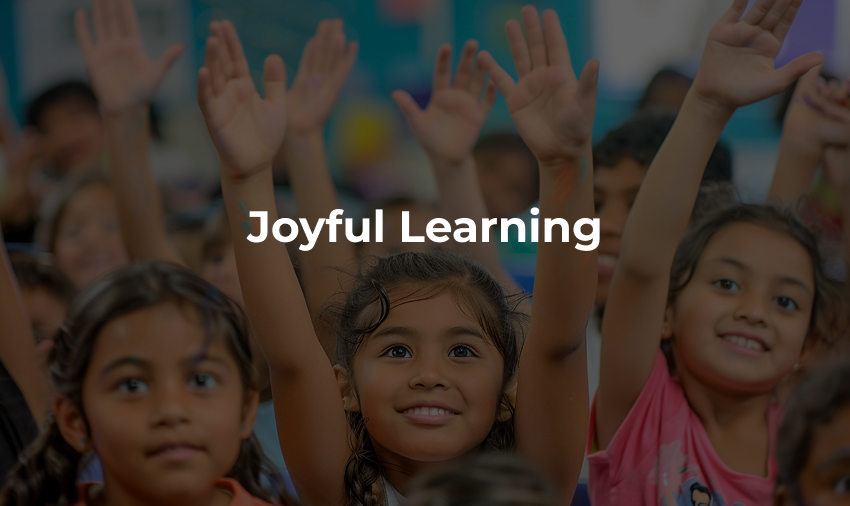
Why is everyone talking about joyful learning?
Joyful learning has become the talk of the town. Walk into a conversation about modern education, and it is never long before the topic turns to joyful learning. This is not simply an educational trend; it is a growing response to something many parents and teachers have been silently observing for years: children who are disengaged, stressed and learning by rote rather than by authentic curiosity. Some of the best preschools in Hyderabad, such as Glendale Academy, encourage inquiry-based learning over rote learning. A school-based survey of 1426 students from CBSE schools in Belgavi, Karnataka, found that 74% reported high levels of academic pressure, with an additional 17% reporting medium levels, indicating that almost 91% of students were under significant pressure. This is a striking signal that something in the traditional approach to learning needs to change. The good news is that the focus is shifting. Educators, schools and researchers are all actively exploring how to bring joy back to the classroom.How is joyful learning different from traditional learning?
‘How to engage students in learning?’ is a question we are sure is on the minds of all parents. The answer to this incessant question is Joyful Learning, a learning method quite different from traditional learning. Traditional learning often centres on instructions, memorisation and standardised testing. It is structured, consistent, and designed to cover content efficiently, but it leaves little room for curiosity, creativity, or the student’s voice. On the other hand, joyful learning does not discard rigour; it reimagines it. It is student-centred, inquiry-based and built on the understanding that your kids learn the best when they are genuinely interested in what they are exploring. For instance, learning activities in kindergarten will cater to your child’s individual uniqueness. The goal is to make everything meaningful. This table gives you a quick comparison between joyful learning and traditional learning.|
Joyful Learning |
Traditional Learning |
| Curiosity and inquiry driven | Content and syllabus driven |
| Learning through play, exploration and collaboration | Learning through instruction and memorisation |
| Emphasis on process and discovery | Emphasis on outcomes and grades |
| Encourages risk-taking and creativity | Rewards correct answers and compliance |
| Builds intrinsic motivation | Relies on external motivation |
| Holistic growth | Primarily academic growth |
Why is joyful learning important for your child’s development?
Sometimes, all you need for your child is to be happy, engaged and look forward to going to school. Joyful learning is not just about happiness in the moment; it has a far deeper impact on your kid’s development.Cognitive development and deeper understanding
When your young one is happy and engaged, they will be more receptive to learning. According to an article by neuroscientist Judy Willis, removing joy and comfort from the classroom will distance students from making sense of new information and from long-term memory storage. To put it simply, joy in learning is what makes it stick.Emotional and social growth
Joyful learning shapes youthful minds and builds resilience. When students encounter challenges from a place of general well-being, they are more likely to approach difficult moments with a positive outlook rather than feeling defeated.Academic performance and lifelong learning
Joyful learning plants the seeds for a love of learning that lasts well beyond the classroom. It is only when your young one associates learning with curiosity and discovery that they’ll grow into adults who keep seeking knowledge, keep asking questions and keep growing.How is joyful learning implemented in classrooms?
Joyful learning does not necessarily mean that the programme has to be redesigned from scratch. It starts with meaningful, intentional choices that shift the classroom’s feel. This takes the form of interactive teaching methods, such as incorporating joyful learning activities that are always tied to the lesson objectives, giving students frequent opportunities to practise and apply their learning. Kindly note that joyful learning is a philosophy, and every teacher finds their own way to deliver it. What this looks like depends on age, ranging from educational activities for kindergarten to research essays for secondary grades.|
Age Group |
Example activities |
Skills Developed |
| Early years (3-6) | Building play, storytelling, pretend play | Language, social-emotional skills, cognitive |
| Primary (6-11) | Reasoning games, hands on science, guided play | Numeracy, critical thinking, inquiry |
| Middle school (11-14) | Collaborative debates, creative projects | Communication, teamwork, analysis |
| Secondary (14-18) | Student-led research, interdisciplinary projects | Leadership, research skills, self-learning |