
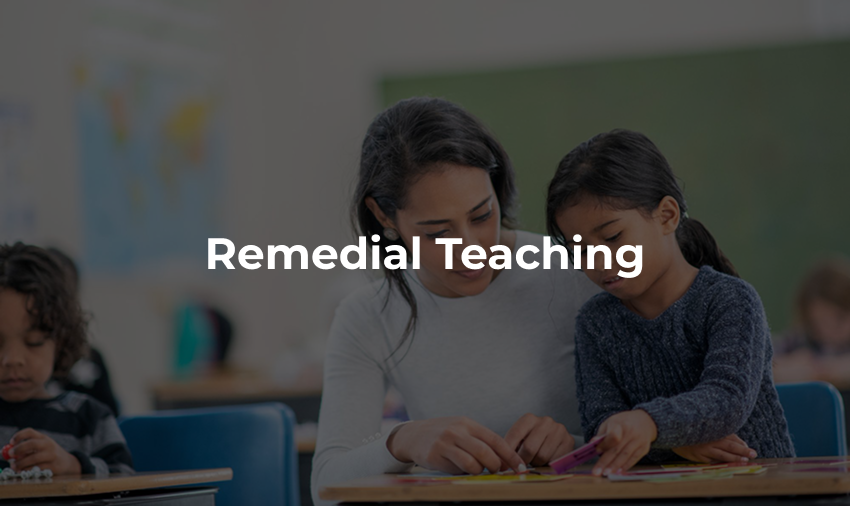
Every parent has seen it happen. Your child studies, attends class, and still struggles with certain topics. It can be confusing and worrying. At school, we see this often. Children learn in different ways and at different speeds. Some need extra guidance to build clarity and confidence. That is where structured academic support becomes valuable. When gaps are addressed early, students regain momentum and enjoy learning again. Let us help you understand how this works and when it might benefit your child.
What is remedial teaching?
At our school, we define remedial teaching as focused academic support designed to help students strengthen their fundamentals in specific subjects. Instead of moving ahead with confusion, students revisit concepts in a guided and supportive way.
It forms part of wider remedial education, which aims to close learning gaps, reinforce core skills, and help children participate confidently in the classroom.
Types of Learning Support in Schools
|
Support Type |
Purpose |
Who Benefits |
|
Classroom Differentiation |
Adjusting lessons for mixed abilities |
Students needing minor help |
|
Remedial Sessions |
Focused concept clarity |
Students with learning gaps |
|
Specialist Support |
Intervention by trained educators |
Students with learning challenges |
|
Enrichment Programmes |
Advanced exploration |
Students ready for deeper learning |
Why Is Remedial Teaching Important for Students?
The importance of remedial teaching becomes clear when we look at how children respond to clarity. When concepts make sense, participation improves and stress reduces.
From our experience in classrooms, it helps because it:
- Strengthens foundational understanding
- Prevents small gaps from becoming larger obstacles
- Encourages students to engage in lessons again
- Supports steady academic progress
- Builds confidence through achievable success
Students who receive timely guidance often develop stronger study habits and a more positive approach to learning.
How Does Remedial Teaching Help Students Academically and Emotionally?
Remedial support works on both performance and confidence.
Academically, it helps students:
- Understand concepts through step-by-step explanations
- Practise skills in a structured way
- Improve reading, writing, and numerical ability
- Develop better problem-solving approaches
Emotionally, it helps students:
- Feel safe asking questions
- Overcome fear of mistakes
- Gain confidence in their abilities
- Stay motivated in class
When children realise they can improve, their attitude towards learning changes significantly.
Who Needs Remedial Teaching?
Many parents think only struggling students need extra support. In reality, different situations may call for it.
Students who may benefit include:
- Children facing difficulty in particular subjects
- Students returning after long absences
- Learners adjusting to a new curriculum
- Children who need extra time to process concepts
- Students who hesitate to ask questions in class
Across schools in Hyderabad, educators increasingly view early support as part of responsible teaching practice.
What Are the Key Characteristics of Effective Remedial Teaching?
Effective support follows a thoughtful structure. Characteristics of Good Remedial Teaching:
|
Characteristic |
Impact |
|
Personalised learning goals |
Focuses on actual gaps |
|
Short, frequent sessions |
Improves retention |
|
Continuous feedback |
Tracks progress clearly |
|
Encouraging environment |
Builds confidence |
|
Engaging materials |
Maintains interest |
Educational research also highlights that students respond best when support is respectful, consistent, and progress-driven.
What Methods Are Used in Remedial Teaching?
At our school, we use a mix of structured remedial teaching strategies depending on student needs.
These may include:
- Diagnostic assessments to identify specific gaps
- Small-group sessions for guided learning
- Individual mentoring for targeted support
- Visual aids and concept mapping
- Practice worksheets focusing on weak areas
- Digital learning tools to reinforce understanding
Many International Schools in Hyderabad are now combining teacher-led support with technology to make learning more personalised.
Remedial Teaching vs Extra Tuition: What’s the Difference?
|
Factor |
Remedial Teaching |
Extra Tuition |
|
Purpose |
Strengthen understanding |
Improve performance speed |
|
Approach |
Diagnostic and personalised |
Syllabus-based practice |
|
Focus |
Core concepts |
Exam readiness |
|
Delivery |
School-led support |
External coaching |
|
Outcome |
Long-term academic stability |
Short-term improvement |
Parents usually choose remedial sessions when clarity matters more than marks alone.
When Should Parents Consider Remedial Teaching for Their Child?
You may wish to explore support if you notice:
- Repeated confusion in the same topics
- Avoidance of homework or tests
- Loss of interest in class
- Teacher feedback about weak fundamentals
- Reduced confidence during discussions
The best IGCSE schools in Hyderabad encourage early intervention because it leads to smoother progress later.
Is Remedial Teaching the Right Support for Your Child?
Every child deserves the chance to understand concepts clearly and feel confident in class. When learning gaps are addressed early, students progress with greater ease and self-belief.
If you would like to understand how structured support works at Glendale, our academic team would be happy to guide you on the best approach for your child.