
Key Takeaways
|
Turning two is a big milestone. They start to gain foundational skills and start navigating social situations. Children at this are like little explorers, soaking everything as they go. Enrolling them at a pre-nursery at this age is a good decision. It gives their curiosity a safe and structured environment to grow and evolve. In the right pre-nursery, your kids can take the first step into becoming capable, confident individuals, make friends and discover a quest for learning. The goal of a good pre-nursery school isn’t to rush developments but to develop a rich interactive and safe environment that can support their curiosity to learn the “why” of things.
This guide is to walk you through what your 2-year-old will learn as a part of their per-nursery syllabus and how it will help improve their cognitive, social and physical skills.
What Is Pre-Nursery and Why Does It Matter at Age Two?
Pre-nursery, also known as playgroup or playschool, is a child’s first introduction to a formal education setting. In India, the usual age to get enrolled in a pre-nursery is 2 to 3 years. A pre-nursery curriculum should be a strong consideration for your 2-year old because:
- It focuses not on academics, but comfort, curiosity and confidence.
- Children get exposed to an interactive environment that helps them learn through play and not worksheets.
- The objective is to make the child ready for school and not just exams.
- It focuses more on developing gross and fine motor skills through engaging activities such storytelling and music. This helps in the cognitive development of your child.
Why Is Age Two Such a Critical Learning Window?
Age two is critical as the brain grows faster at this age than any other time. As per the Ministry of Women and Child Development, a child’s brain grows 85% before the age of 6. Hence these years provide a great learning window.
- According to India’s National Education Policy (NEP) 2020, over 85% of a child’s brain development occurs before the age of six, which is why the policy places early learning at the centre of the new 5+3+3+4 school structure.
- NEP 2020 groups ages 3 to 8 as the “foundational stage,” treating three years of early childhood education and the first two years of school as one continuous learning journey.
- ASER 2024 survey data shows that enrollment of 3-year-olds in pre-primary institutions rose to 77.4% in 2024, up from 68.1% in 2018, reflecting how mainstream pre-nursery and nursery education has become.
- India’s Anganwadi network, the government’s own early learning system, runs through over 1.3 million centres, showing how seriously early education is now treated nationwide.
What Does a Strong Pre-Nursery Curriculum Actually Cover?
A good pre-nursery curriculum is built around developmental domains, not subjects. It can be typically broken down into:
|
Development Area |
What a 2-Year-Old Learns |
How It Shows Up in Class |
|
Motor Skills |
Running, climbing, holding a crayon, stacking blocks |
Outdoor play, art corners, sensory bins |
|
Language |
New words, simple sentences, listening to stories |
Storytelling, rhymes, picture books |
|
Cognitive Skills |
Colours, shapes, sorting, cause and effect |
Puzzles, matching games, music |
|
Socio-Emotional Skills |
Sharing, turn-taking, expressing feelings |
Group play, guided interactions |
|
Independence |
Washing hands, eating on their own, tidying up |
Daily routines, self-help tasks |
How Does a Typical Pre-Nursery Day Look Like?
Structure helps toddlers feel secure. It is designed to make children feel secure, encouraged and learn new skills in a safe and supportive environment. A typical day in pre-nursery looks like:
- Arrival & Free Play: Children settle in, explore toys, and interact with friends in a welcoming environment.
- Circle Time: Songs, rhymes, greetings, and simple conversations introduce the day’s theme.
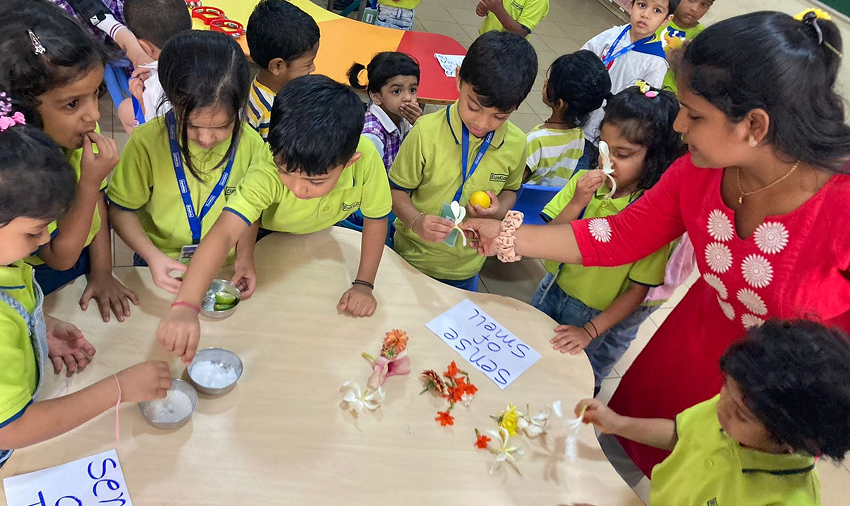
- Learning Through Play: Hands-on activities help children explore early concepts like colors, shapes, numbers, and letters.
- Snack Time: A short break to enjoy a healthy snack and practice independence.
- Outdoor Play: Active games and playtime support physical development and social skills.
- Creative Activities: Art, music, dance, crafts, and imaginative play encourage creativity and self-expression.
- Story Time: Engaging stories build listening, language, and imagination.
- Goodbye Circle: A cheerful wrap-up with songs and a quick recap before heading home.
What Skills Should Parents Expect their Child to Build?
Pre-nursery is much more than preparing your child for school. They are a protective space where children can develop essential skills that provide for emotional, social, cognitive and physical growth. Parents can see their children develop important skills that include:
- Thinking and Problem-Solving Skills: Preschoolers are in general very curious with their “Why?” and “How?” questions. A good pre-nursery curriculum helps build this curiosity into activities that build thinking and problem-solving abilities in your children.
- Talking, Listening, and Early Reading: Language is the basis of learning. In pre-nursery, children are surrounded by reading, singing, conversations and storytelling that build listening skills in children, improve their diction and also help them to express themselves more clearly.
- Movement and Coordination: Children at this age are highly active and full of energy. Pre-nursery schools channel this among the active energy of the children into productive activities such as playing games, holding crayons and more. This helps develop both the gross as well as fine motor skills among children.
- Creativity and Imagination: A pre-nursery is full of activities that helps your child explore their creative side and use their imagination to create new things. By getting the children engaged in story-telling, playhouse, shopkeeper and more, the pre-nursery schools helps develop their problem-solving skills and express emotions.
- Social Comfort: Playing alongside other children from the same age group allows the children to make new friends and blend in a new environment more organically. This creates a sense of comfort and familiarity among the children.
Where and How Do Parents Begin Nursery Admission in Hyderabad?
For nursery admission in Hyderabad, parents need to go through a simple process. This includes:
- Online Registration: Parents fill out a basic enquiry form asking for their child’s details.
- Informal Interaction: The schools arrange relaxed sessions to observe and read the child’s natural behaviour.
- Observation Period: The teachers set milestones, communications and peer engagements to see how your child reacts to it.
- Playway Assessment: Shortlisted children take part in child-friendly, play-based activities.
- Admission Decision: After careful observation, the school confirms the offer and shares the further steps for enrolment.
How Do You Know Your Child Is Ready For Pre-Nursery?
If you are wondering if your child is ready to get enrolled in pre-nursery or not, observe their actions closely. Check if they are showing curiosity about the things around them. Are they able to stay away from you for a while? Every child develops in their own timeline. A well-designed pre-nursery syllabus is one that meets your child where they are and helps them grow from there.
A Final Word From Glendale School
Finding the right pre-nursery entails locating a place where children can feel secure, appreciated, and free to discover, play, and learn according to their own preferences. At Glendale, we strongly believe that all children deserve an opportunity to have an enjoyable learning experience. Recognized as one of the top international schools in Hyderabad, we offer a blend of play-based education and world’s best practices to build their social, emotional, physical, and cognitive skills.
Because we have branches in Suncity, Financial District, and in Tellapur, the parents can select the necessary school depending on which area they live in. Parents interested in schools in Suncity Hyderabad, schools in Financial District Hyderabad, or or IB syllabus schools in Hyderabad can find a warm and friendly atmosphere to feel comfortable in.
According to our beliefs, each child has his/her own way of learning, and playing with him/her creatively is something we must do from the very first years.
FAQs
A two-year old typically works on motor skills, listening skills, creativity and simple independence all through play-based activities.
It is not necessary but pre-nursery helps build confidence and creates social comfort in a child before entering a more challenging educational environment.
Most children start pre-nursery at a very nascent stage of their childhood- around 2-years of age. However it depends a lot on the readiness of your child
A pre-nursery syllabus is mostly designed to encourage sensory play, motor skills and settling in while a nursery syllabus is more advanced delving deeper into language, math and creative arts.
Parents should take note of the teacher-student ratio, curriculum options, infrastructure, safety, and how the school handles admissions for very young children. A good management is what separates the best schools in Hyderabad for nursery from the rest.