Imagine your child coming home from school and saying, “Mamma, today I was a cloud.”
You ask them what they mean. They tell you they pretended to be a cloud, holding water until they got heavy, and then they rained all over the classroom. They are laughing. They are excited. And somewhere in that game, they actually understood the water cycle.
That is the kind of learning we are talking about here. In a world where we are constantly worried about exams, grades, and competition, it is easy to forget that children learn best when they are happy. When they are moving. When they are creating. That is exactly what Art Integrated Learning brings to the table: one of the most joyful learning activities.
What Is Art Integrated Learning?
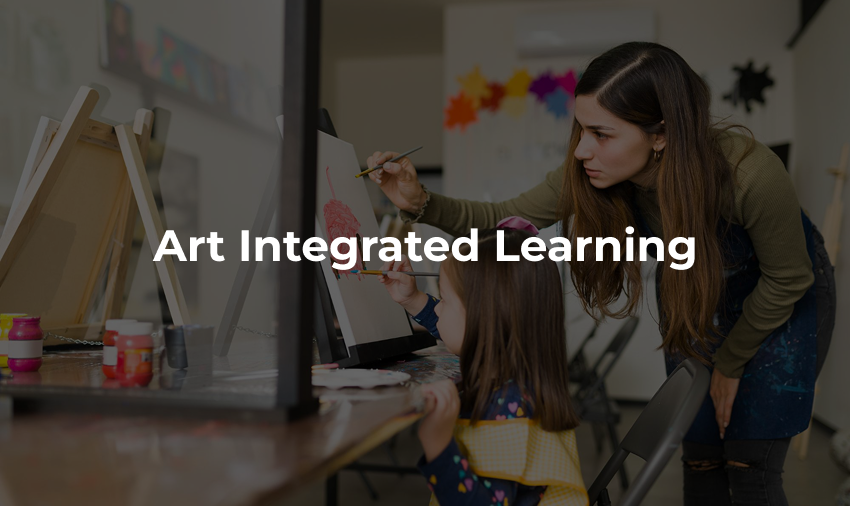
In simple terms, Art Integrated Learning means using art to teach subjects like Maths, Science, or Languages. It is not an extra drawing period. It is about using a paintbrush to understand symmetry, or using a folk dance to learn about the seasons. It makes learning feel less like a task and more like a game. In fact, it is one of the most effective ways to bring joyful learning into a child’s daily routine. When a child enjoys what they are doing, they don’t resist it. They lean in.
Why Is Art Integrated Learning Recommended by NEP 2020?
The National Education Policy (NEP) 2020 is probably the most honest conversation we have had about education in a long time. It admits that memorising facts and vomiting them onto an exam paper isn’t working. It asks us to focus on understanding, not just memory.
The NEP recommends Art Integrated Learning because it brings subjects to life. It connects education to the real world. It also connects children to their own culture. A child learning about Bihar in Social Studies might create a Madhubani painting to better understand the region. They are not just reading about a place. They are touching its art, its colours, and its stories.
Here is how the goals of NEP 2020 line up with what Art Integrated Learning offers:
|
NEP 2020 Wants This |
Art Integrated Learning Does This |
|
Children to think critically |
They solve problems through creative projects |
|
Education to be less stressful |
Art makes learning playful and pressure-free |
|
Students to value Indian culture |
They work with local art forms and traditions |
|
Learning to be hands-on |
They build, paint, and perform instead of just listening |
What Are the Key Objectives of Art Integrated Learning?
- To help children understand concepts by experiencing them, not just reading about them.
- To make the classroom a place where children feel safe to express themselves.
- To introduce students to India’s artistic traditions in a way that feels natural and fun.
- To build confidence in children who may not shine in traditional tests but have other strengths.
What Are the Benefits of Art-Integrated Learning for Students?
- They remember more. When a child acts out a historical event, they are far more likely to remember the details than if they had simply read the chapter.
- They feel less anxious. Art has a way of calming the mind. For young children, especially, it removes the fear of “getting it wrong.”
- They learn to work with others. Most art projects involve collaboration. Children learn to share ideas, negotiate, and create together.
- It builds curiosity. When learning is fun, children start asking questions. They want to know more. That curiosity is the foundation of everything.
Examples of Art Integrated Learning in the Classroom
In a good school, you will see this happening naturally. It is not forced. It is woven into how the teacher plans the day. For example, during a lesson on the monsoon, children might listen to the sound of rain and try to recreate it with their hands and voices. They are learning about the season, but they are also learning to listen, to observe, and to create.
Here is a look at how different subjects can blend with art:
|
Subject |
How Art Comes In |
|
Mathematics |
Creating rangoli patterns to understand symmetry and angles |
|
Science |
Using body movements to show how plants grow or planets move |
|
Social Studies |
Building miniature models of historical monuments |
|
Language |
Acting out a story from the Panchatantra |
When a school designs learning activities for kindergarten children, these methods work beautifully. Little ones learn best when they are moving and playing. It is how their brains are wired.
Art Integrated Learning vs Traditional Teaching Methods
Most of us grew up in a system where the teacher talked, and we listened. We sat in rows. We copied notes. We memorised answers. It worked, kind of. But how much of it do we actually remember?
The difference with AIL is that it respects how children actually learn. A child is not an empty vessel to be filled. They are a small person with questions, energy, and creativity. If we want to know how to engage students in learning, the answer is simple: let them do things. Let them make things. Let them mess up and try again.
|
Traditional Teaching |
Art Integrated Learning |
|
The teacher is the only speaker |
Everyone participates |
|
Right answers matter most |
The process and effort matter too |
|
Children sit quietly |
Children move and create |
|
Learning is individual |
Learning is often collaborative |
|
Focus is on finishing the syllabus |
Focus is on understanding the concept |
How Can Schools Successfully Implement Art Integrated Learning?
It takes thoughtfulness. It takes teachers who are willing to plan a little differently. It means letting go of the need for perfect, quiet classrooms. A school that wants to do this well will invest in training its teachers. It will bring in local artists. It will look at the curriculum and ask, “Where can art live here?”
For parents looking at preschools in Nallagandla, this is something to watch for. Does the school seem rigid? Or do the children look happy and engaged? Do they have space to play and create? These are good signs.
Conclusion
We live in a time where information is everywhere. A child can Google anything. So, the role of a school is no longer just to deliver facts. It is to teach children how to think, how to feel, and how to express themselves. Art Integrated Learning does exactly that. It prepares them not just for exams, but for life.
At Glendale, we believe in this approach deeply. If you are looking for the best preschool in Hyderabad, we would love to show you how we bring learning to life. We are also here for families searching for admission in preschool and wanting a place where their child will be happy, challenged, and supported. Come visit us. Let your child spend a day with us. See for yourself what learning looks like when art is part of the picture.