
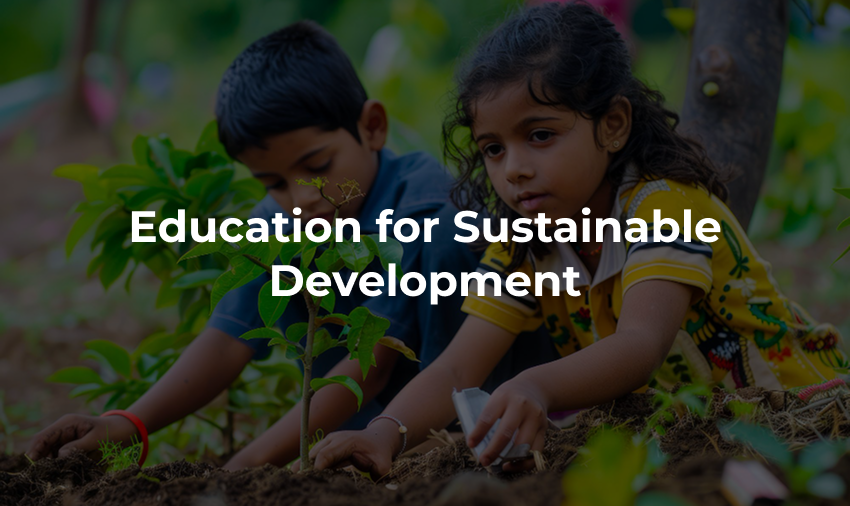
What is Education for Sustainable Development?
Education for Sustainable Development, or ESD, is a way of learning that helps children understand how their choices today affect the world tomorrow. Think of it as teaching your child to see the bigger picture: how energy, water, food, society, and the economy are all connected. UNESCO defines it as learning that empowers people to make decisions and take actions to transform their societies and the environment for the better.
A simple way to explain it to your child: imagine two students both studying about forests. One memorises facts for an exam. The other learns why forests matter, what happens when they disappear, and what actions they can take in daily life. The second student is receiving an education for Sustainable Development. The difference lies in purpose and action.
Why Does Education for Sustainable Development Matter in India?
India has a rich environmental legacy, but the pressures of rapid growth make sustainability more urgent than ever. According to research by Climate Change in the Indian Mind, Spring 2025, 89% of Indians consider climate change a serious threat. Yet a separate study found that only 43% of Indians clearly understand the link between greenhouse gas emissions and global warming. That gap between awareness and understanding is precisely where schools have a role to play.
India’s National Education Policy 2020 explicitly aligns with SDG 4.7 of the United Nations, which calls for all learners to acquire the knowledge and skills needed to promote sustainable development. This makes the role of education for Sustainable Development a national priority, not a niche subject.
What is the Education for Sustainable Development Goals?
The education for sustainable development goals broadly aligns with the United Nations’ 17 Sustainable Development Goals (SDGs), particularly SDG 4 (Quality Education), SDG 13 (Climate Action), and SDG 12 (Responsible Consumption and Production). Here is a practical breakdown of what these goals look like inside a classroom:
SDG Goal | What It Means for Students | Example in School |
SDG 4 (Quality Education) | Learn to think critically and creatively | Project-based learning, inquiry classrooms |
SDG 12 (Responsible Consumption) | Understand resource use and waste | Waste audit projects, upcycling drives |
SDG 13 (Climate Action) | Know how to respond to climate challenges | Climate debates, carbon footprint tracking |
SDG 11 (Sustainable Communities) | Appreciate how communities are built | Community mapping, local history studies |
What are the Key Terms Parents Should Know?
When reading about ESD in school brochures or parent meetings, you may come across these terms. Here is what they actually mean:
- Sustainability: Meeting today’s needs without compromising the ability of future generations to meet theirs.
- Systems Thinking: Understanding that everything is connected. For example, a student learning why cutting down trees affects rainfall in their own city.
- SDGs (Sustainable Development Goals): 17 global goals set by the United Nations in 2015, to be achieved by 2030.
- Active Learning: Learning by doing, debating, building, and exploring, rather than only memorising.
- Global Citizenship: The understanding that students are part of a wider world and carry responsibilities toward it.
What is the Role of Education for Sustainable Development in Schools?
The role of education for Sustainable Development in schools goes well beyond a subject on a timetable. It shapes how children think, solve problems, and act as citizens. At Glendale International School, this philosophy is part of how we design learning experiences across CBSE, Cambridge, and IB curricula. At Glendale International School, the principles of sustainable development are reflected through inquiry-led learning, real-world projects, and opportunities for students to engage with global issues. Across the CBSE, Cambridge, and IB curricula, students are encouraged to examine environmental, social, and economic challenges from multiple perspectives and develop informed solutions. Classroom learning is complemented by collaborative activities that promote responsible decision-making, critical thinking, and community awareness. By connecting academic concepts with real-world contexts, Glendale helps students understand the importance of sustainability and their role in contributing to a better future.
Schools, particularly the best international schools in Hyderabad, are integrating ESD through interdisciplinary projects, student-led initiatives, and community service that connect classroom knowledge to real-world action.
How Do Schools Implement Education for Sustainable Development Goals?
Here is how responsible schools embed the education for sustainable development goals into everyday life:
- Curriculum Integration: Sustainability themes appear across subjects. Science explores ecosystems. Economics discusses resource management. Literature explores human impact on nature.
- Experiential Learning: Students conduct waste audits, visit urban farms, or run school recycling programmes.
- Teacher Training: Educators are trained to facilitate inquiry-based discussions rather than deliver information passively.
- Student Agency: Students lead sustainability clubs, design eco-campaigns, and present solutions to real community problems.
Many of the best CBSE schools in Hyderabad have begun incorporating the NEP 2020 mandate for holistic and experiential learning, which naturally aligns with ESD principles.
Which Skills Does ESD Build in Children?
As a parent, here is what you can expect your child to develop through sustained ESD exposure:
Skill | Why It Matters | How It Shows Up at Home |
Critical Thinking | Students question and evaluate information | Your child asks ‘why’ before accepting anything at face value |
Empathy | Understanding diverse perspectives | Greater awareness of how classmates and communities are different |
Problem-Solving | Turning complex issues into actionable steps | Proposing solutions to neighbourhood or family challenges |
Collaboration | Working with others toward shared goals | Leads group projects with patience and communication |
Conclusion
Education for Sustainable Development helps students become thoughtful, responsible, and future-ready individuals. Beyond academics, it equips children with the skills to solve real-world problems, make informed decisions, and contribute positively to society and the environment.
At Glendale International School, sustainability is woven into learning through inquiry, collaboration, and real-world experiences, helping students develop into confident global citizens.
Ready to Learn More?
Discover how Glendale International School nurtures future-ready learners through its CBSE, Cambridge, and IB programmes. Book a campus tour or get in touch with our admissions team today.
FAQs
There is no minimum age. Even young children can learn to sort waste, save water, and care for plants. ESD adapts to developmental stages, growing in complexity as children grow.
They overlap, but ESD is broader. Environmental education focuses primarily on nature and ecology. ESD covers environmental, social, and economic dimensions together, helping students understand how all three are connected.
Discuss current events. Reduce single-use plastics as a family. Ask your child what problems they would solve in their neighbourhood. These small conversations reinforce what schools are building in the classroom.
Education for Sustainable Development at Glendale is woven across subject areas, extra-curricular activities, and student-led initiatives. Our students learn to think globally and act locally, supported by teachers trained in inquiry-based and project-based learning methods.


