
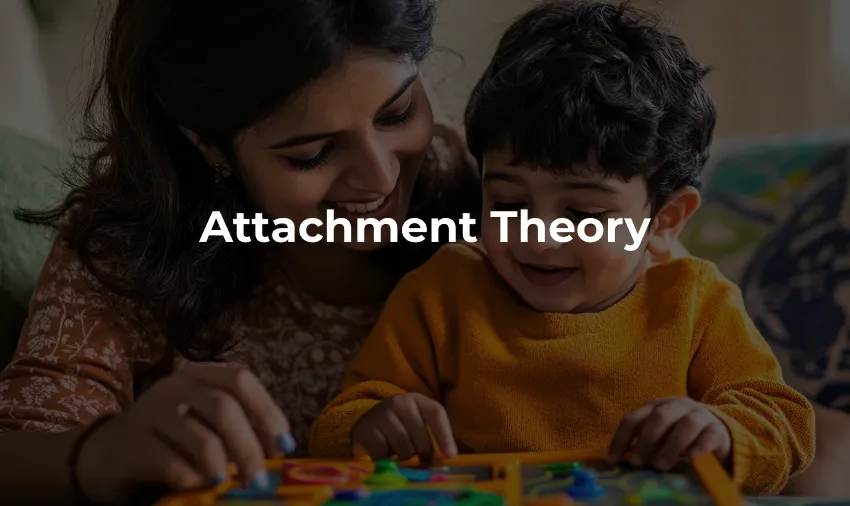
Attachment Theory explains how young children build emotional bonds with their primary caregivers and how those bonds influence their social, emotional and cognitive development. In simple terms, it is about how children learn to trust, explore and express themselves based on the security they feel with their parents or guardians.
First introduced as the theory of attachment, this concept highlights why a baby reaches for familiar arms and why school-age children thrive in nurturing, predictable environments.
Who Developed Attachment Theory and Why Does It Matter Today?
The roots of modern attachment theory psychology lie in the pioneering work of Bowlby Attachment Theory. The framework, also known as attachment theory by John Bowlby, emphasises that early relationships act as internal working models. They shape how children understand safety, relationships and emotional responses.
Even decades later, this theory remains crucial in early childhood education. Whether in homes or nurturing environments like an IB school in Hyderabad, children benefit immensely from learning in spaces where emotional security meets academic excellence.
What Are the Main Types of Attachment in Early Childhood?
Understanding the types of attachment helps educators and parents recognise children’s emotional needs. The four commonly studied types include-
1. Secure Attachment
Children feel protected, supported and confident enough to explore. They trust that caregivers will return and respond to their needs. These children tend to be more resilient, social and expressive.
2. Avoidant Attachment
Here, children appear unusually independent. They may avoid seeking comfort because past attempts didn’t feel rewarding. They might seem self-reliant, but often struggle with emotional expression.
3. Ambivalent/Resistant Attachment
Children with this attachment style are unsure whether their caregivers will respond consistently. They may cling, show anxiety or be hesitant to explore.
4. Disorganised Attachment
Often linked to irregular caregiving, this style leads to confusion and mixed behaviours in children. They might exhibit both clinginess and avoidance due to fear or unpredictability.
Educators trained in attachment theory psychology can recognise these behaviours and create environments that encourage healthier emotional patterns.
How Does Attachment Influence Early Childhood Development?
Early attachment does not just shape emotions; it forms the foundation for future learning and behaviour. Here’s how-
1. Emotional Regulation
Securely attached children handle stress better. They learn to soothe themselves, ask for help and navigate big feelings. These are important for classroom success and beyond.
2. Cognitive Growth
Children explore more when they feel safe. This curiosity leads to stronger problem-solving skills, better memory and more enthusiastic engagement with learning.
3. Social Skills
Healthy attachment promotes kindness, empathy, conflict resolution and positive peer relationships.
4. Resilience
When children know they have dependable adults around them, they bounce back from difficulties with greater confidence.
How Does Attachment Theory Support Learning in Schools?
Teaching environments that prioritise attachment theory help children feel valued, understood and secure. This includes-
- Predictable routines
- Warm, responsive teacher interactions
- Opportunities for independent and collaborative learning
- Emotion-friendly classrooms that promote confidence
Top-tier institutions like the best Cambridge schools in Hyderabad follow holistic frameworks where emotional growth is given equal priority to academic excellence.
How Can Attachment Theory Be Observed in Classrooms?
Parents searching for schools near Bandlaguda Jagir often look for environments where children feel safe, stimulated and understood. Schools that incorporate practices that focus on theory attachment-
- Greet each child warmly
- Encourage open communication
- Provide creative, inquiry-driven learning experiences
- Ensure teachers act as secure, supportive figures
This approach reduces anxiety and helps children transition smoothly from home to school, especially during preschool and primary years.
How Does Attachment Theory Guide Parents During School Admissions?
When considering schools admission in Hyderabad, parents often evaluate academic programmes, campus facilities and extracurricular options. However, understanding the theory of attachment helps them consider deeper questions, such as-
- Will my child feel emotionally supported?
- Are teachers trained to understand behavioural cues?
- Does the school promote independence with reassurance?
These factors strongly influence long-term confidence and academic success.
How Can Parents Strengthen Attachment at Home?
Here are simple, powerful ways to build secure attachment-
- Respond promptly and sensitively to your child
- Establish regular routines and rituals
- Encourage play, curiosity and exploration
- Maintain open conversations about feelings
- Offer consistent praise, comfort and boundaries
Even small daily habits deepen trust, communication and emotional stability.
Why is Glendale a Leader in Nurturing Secure and Confident Young Learners?
While there are broader topics of attachment, it is worth noting why Glendale stands out. As one of the top choices among parents exploring the best Cambridge schools, Glendale provides-
- Emotionally supportive classrooms
- Child-centred teaching aligned with global curricula
- Teachers are trained to understand each child’s developmental needs
- A warm, inclusive environment where attachment-based practices thrive
Glendale believes that strong emotional foundations inspire strong academic futures, exactly what attachment theory advocates.
With its holistic approach, nurturing culture and world-class learning ecosystem, Glendale ensures children feel secure, valued and inspired every single day. It is not just a school; it is a place where confidence is built, curiosity is celebrated and lifelong learners are shaped with care.