
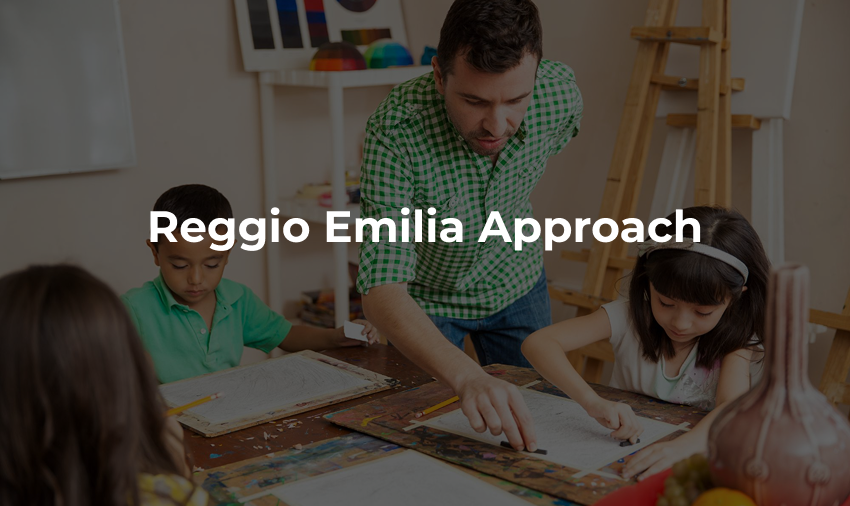
Thinking of enrolling your little one in a school that values curiosity, creativity and child-led discovery? Let’s dive into the Reggio Emilia Approach and explore its many benefits.
If you are checking out pre primary schools in Hyderabad; this might help you see what truly matters in early years.
What is the Reggio Emilia Approach (or Reggio Emilia Method)?
Simply put, the Reggio Emilia Approach (also called the Reggio Emilia Method) is a philosophy for early childhood education that sees children as capable and creative thinkers. Instead of a rigid schools curriculum; it is flexible, child-driven and rooted in inquiry. It is a part of the broader conversation about what is early childhood education and not just playtime or babysitting; it’s a rich educational experience with purpose.
In the Reggio Emilia system, the education system supports children to explore and ask questions to express themselves. They may express themselves through many languages like art, movement, storytelling, building, music and more. Teachers act as facilitators, observing children’s interests and guiding exploration rather than dictating what to learn.
What are the core principles and how do they show up in class?
There are some guiding ideas that define the Reggio Emilia approach-
- Environment as the Third Teacher– The classroom space is thoughtfully designed to inspire and support learning.
- Emergent curriculum / flexible programme– Instead of a fixed schedule, themes and projects arise from children’s interests.
- Hundred Languages of Children– Children express themselves in many ways beyond words: drawing, movement, sculpture, drama.
- Documentation & Reflection– Teachers document children’s explorations (photos, transcripts, sketches) to reflect, plan next steps and make learning visible.
- Collaboration & Community– Children work together; families and community are partners in education.
In classrooms, you might see open-ended materials (loose parts, clay, natural materials), project corners and flexible spaces rather than rows of desks.
What are the benefits of using the Reggio Emilia Approach in early years?
The advantages are many and they are precisely the reasons why Glendale is considered one of the reputed and best international schools in Hyderabad. Here are the standout benefits-
- Enhanced curiosity & agency– Children learn to ask questions and take ownership of their learning.
- Problem-solving & critical thinking– Open tasks and inquiry nurture these skills.
- Creativity & expression– With multiple languages; children express themselves in art, music and drama.
- Social & emotional growth– Collaboration, empathy and conflict resolution naturally arise in group projects.
- Stronger communication– Children articulate ideas, discuss, negotiate meaning with peers and teachers.
- Deep, meaningful learning– Projects are sustained, allowing children to explore ideas in depth rather than superficial coverage.
The Reggio Approach is also linked to improved socio-emotional skills and later achievement compared to no early childcare.
Are there any challenges or things to watch out for?
Yes; no approach is perfect. Here are a few caveats to keep in mind-
- Children who prefer structure may feel uneasy in highly fluid settings.
- It demands skilled teachers who can observe, plan, and scaffold without overtaking.
- Measuring standard outcomes (test scores) is harder because learning is more open-ended.
- Sometimes, a lack of structure can frustrate children in a hurry or parents expecting strict routines.
But when well-implemented, these drawbacks are often outweighed by the deep, intrinsic growth children enjoy.
How does this relate to schools in Hyderabad and admission choices?
If you are exploring schools admission in Hyderabad; it helps to know which schools are adopting progressive and child-centred philosophies. Some schools blend the Reggio Emilia Approach with more structured curriculum elements, giving children both freedom and support.
When touring schools, ask-
- How flexible is the curriculum?
- How do teachers respond to children’s interests?
- How is classroom documentation shared with parents?
- What is the balance between child-led projects and more structured learning?
Schools that truly embrace these values often stand out for their holistic approach to early childhood and education.
Tips for parents: What to Look for and How to Support at Home?
- Look for inviting environments– Natural light, materials and open shelves to display their work.
- Engage in their explorations– Ask open questions.
- Encourage multi-media expression– Give children art materials, clay, building tools or nature items to explore.
- Document & reflect together– Take photos, ask your child to narrate their project journey at home.
- Be patient with mess– Creative learning is often messy and that’s part of it.
- Partner with the school– Attend parent-teacher project exhibitions, share your child’s interests from home.
Final Thoughts
The Reggio Emilia Approach offers a fresh, respectful, and deeply human way of guiding young children’s development. It is less about ticking curriculum boxes and more about nurturing rich minds, curious hearts and empathetic souls.
Understanding philosophies like Reggio helps you choose a school aligned with your values. Combined with strong academics, it can offer the kind of holistic start children deserve. After all; education is not just about what children learn. It is about how they come to learn, who they become as a result and what they carry forward.