
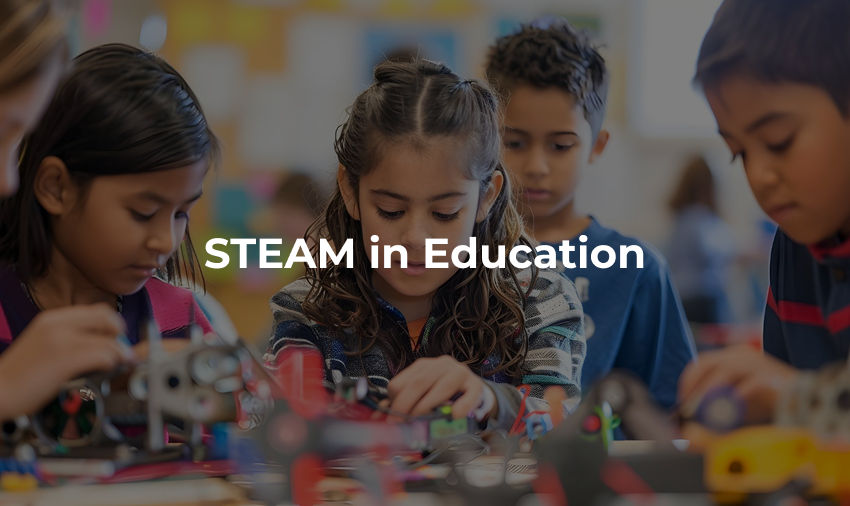
What is STEAM in Education?
STEAM full form in education is Science, Technology, Engineering, Arts, and Mathematics, and the “Arts” part is not just painting, it includes design thinking, creativity, communication, and how you present ideas. Most of you hear the term in school brochures, career talks, or a new lab announcement, but the meaning stays hazy until you see it in your own work. STEAM education is the idea of learning five subjects together so you stop treating them like separate boxes. For an active student, STEAM is less about memorising and more about building, testing, fixing, and showing your thinking. You learn to ask better questions, work with real tools, and explain your result in a way people understand. That is where confidence grows, because you can see your learning in front of you.How Does STEAM Education Work?
In a normal class, you may solve a maths problem, write a science answer, then move on and forget. In STEAM learning, the education moves like a project. You start with a problem that feels real, then you plan a solution, then you try it, and then you improve it after feedback. A simple example: you want to reduce plastic waste in your canteen. You collect data, test materials, design a model, build a small prototype, and explain why your choice works. In this process, you learn maths without fear because it supports your decision. You learn science because it explains the material. You learn technology and engineering because the solution needs structure. You use art because your design must be usable and clear, not messy.Key Components of STEAM Learning
The core parts stay the same, even when the topic changes. You work on a challenge, you research, you build, you test, and you present. STEAM learning also expects teamwork because most good solutions need more than one brain and one skill. Here is a simple table you can use to understand what changes in your daily study:|
Component |
What you do as a student |
What you build in yourself |
|
Problem framing |
Convert a broad topic into a clear question | Focus and clarity |
|
Research |
Read, observe, ask, and collect facts | Strong base thinking |
| Design and build |
Sketch, plan, create, and assemble |
Practical skill and patience |
| Testing | Measure results, find errors, repeat | Discipline and logic |
| Presentation | Explain your work with proof |
Communication and confidence |
Why Is STEAM Important in Modern Education?
Your future work will not come as one clean subject. A product team mixes design, data, coding, and user feedback. A medical startup needs science and engineering, plus clear communication. That is why STEAM in education matters now, not later. India is also changing fast. You see robotics clubs, maker spaces, AI demos, and coding camps in many cities. In places where students already look at options like good international schools in Hyderabad, the trend is clear: schools want learning that prepares you for modern work, not only exams. Even if you study in good schools in Nallagandla Hyderabad or Sun city school, what helps you stand out is how you think and how you build, not only marks.STEAM vs STEM: What’s the Difference?
- STEM focuses on Science, Technology, Engineering, and Maths.
- STEAM adds Arts, and that changes the outcome in a big way.
- Art pushes you to design for humans, not only machines. It pushes you to explain your work, not hide behind technical words.