
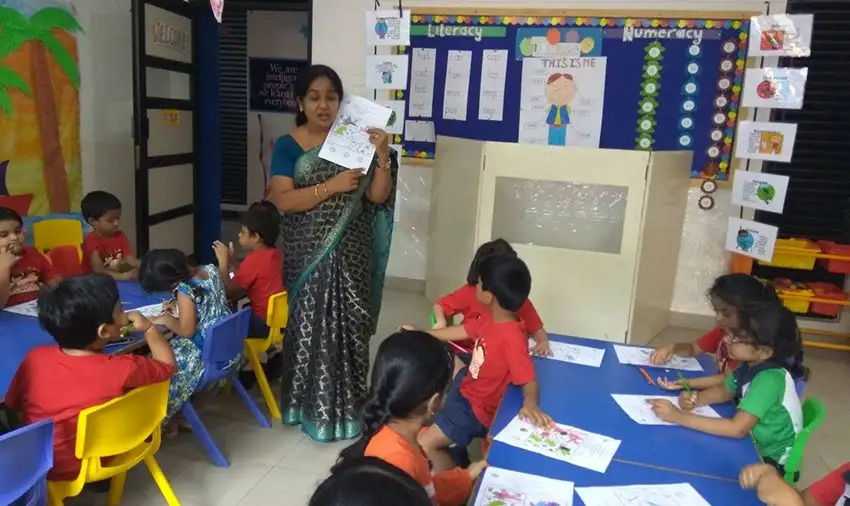
Early childhood is often seen as the beginning of growth and lifelong learning. These important years help children develop the basic skills that shape their academic journey and personal growth.
This is where phonics comes in; it is one of the most effective ways to build early literacy and communication skills.
Phonics teaches kids how to read by associating sounds with letters or letter groupings. Through phonics, kids can also decode a word, which allows them to read with greater fluency, assisting in their communication abilities.
At Glendale International School, one of the top preschools in Hyderabad, we understand the importance of phonics, which plays a crucial role in developing strong reading skills from an early age.
In this blog, we will understand what phonics is and how it builds a strong foundation for a child’s academic and cognitive success.
What is Phonics?
Phonics is much more than memorising the alphabet; it’s a method of teaching reading and writing by connecting sounds with letters and groups of letters.
It helps children hear, identify, and use different sounds that distinguish one word from another in the English language. It helps them understand how written letters relate to spoken sounds.
In simple terms, phonics teaches children to decode words by sounds – showing them the connection between the letters of the written word.
For example, the word “cat,” phonics teaches them to recognise that the letter ‘c’ makes a /k/ sound, ‘a’ makes an /a/ sound, and ‘t’ makes a /t/ sound.
By blending these sounds together /k/ – /a/ – /t/ – the child can decode and pronounce the word.
Importance of Phonics for Kids
The early years are a critical period for a child’s brain development, and phonics is the best way to teach kids to read words. This is well-supported by research and is a better approach than any other when it comes to learning to read.
But why is Phonics important for kids?
Here’s why phonics plays such an important role in early childhood development-
Benefit |
Explanation |
| Build a Strong Reading Foundation | It helps children develop decoding skills. This lets them recognise and read words easily. |
| Improve Writing and Spelling | Children learn how sounds match with letters. This gives them the tools to spell words correctly and write with confidence. |
| Enhance Communication Skills | Clear pronunciation and a growing vocabulary help kids connect sounds and words. This boosts their speaking skills. |
| Fostering a Love for Learning | When a child feels confident and enjoys reading, it sparks curiosity and creates a lifelong love for books. |
| Better Academic Performance | Early phonics education lays a solid groundwork for future academic success. Strong reading and literacy skills are essential. |
How Schools Can Use Phonics in Early Childhood Education?
Schools implement phonics in early childhood education by using a systematic and engaging approach that combines explicit instruction with playful activities.
Here are some of the ways schools can implement phonics in Early Childhood Education:
- Systematic and Explicit Instruction
A successful phonics program must be systematic and explicit. This means letter-sound relationships in a logical sequence, starting with the simplest sounds and progressing to more complex ones.
- Multisensory Learning
Schools also incorporating multisensory activities to make phonics fun and memorable. For example, children can see, hear, touch, and move using flashcards, singing songs, tracing letters in sand, and using hand gestures to represent different sounds.
- Differentiated Instruction
Children learn at their own pace. Differentiated instruction helps each child progress quickly by overcoming challenges. This can be done through:
- Small-group activities: Children with similar needs receive targeted support.
- One-on-one sessions: Offer individual attention to help students master specific concepts.
- Interactive games and technology: Using educational apps and games that adapt to a child’s learning level.
- Phonic Games
Games are a fun and interactive way for children to learn and build their reading skills. They can change the learning experience into something playful and engaging, which helps keep kids motivated.
Games like letter matching, sound bingo, and online phonics apps make learning enjoyable and lower the stress that comes with learning to read.
- Phonic Worksheets
One of the most common ways to implement phonics is by using worksheets where children can practice essential skills such as letter recognition, sound matching, and word formation.
These worksheets can be used in both classrooms and at home to help kids apply what they’ve learned and enhance their understanding.
How Can Parents Help their Children with phonics?
Parents can effectively support their children’s phonics learning through different activities and practice at home. Here are some ways parents can help their children with:
- Turn phonics into fun, everyday learning experiences
Make learning phonics an enjoyable part of a child’s daily life. Point out letters and sounds while travelling, driving, reading, or even during grocery shopping and ask your child to identify the sounds of the letters.
- Create a Language-Rich Environment
Dedicate regular time for phonics practice and celebrate small successes. Surround children with books, both at home and during outings and read to them, which helps them understand new words and sounds.
- Try Rhyming Words
Rhyming games are a fun way for kids to think about how words sound and find other words with similar sounds.
While reading a book, you can ask your child to notice any rhyming words on the page. Alternatively, during dinner, choose a word and encourage everyone to think of a word that rhymes with it.
- Sing
Try adding playful words to a song, poem, or nursery rhyme to highlight just how enjoyable rhyming can be.
How does Glendale International School incorporate phonics into the Curriculum?
At Glendale School, phonics is not just a lesson; it’s a cornerstone of our early education curriculum. As one of the top preprimary schools in Hyderabad, we ensure to make learning enjoyable and inspiring by using play-based and holistic approaches.
We incorporate phonics into various learning activities, including games, outdoor play, and everyday classroom experiences.
At Glendale, our pre-primary programme blends phonics with mathematics, creative arts, environmental studies, and physical education – ensuring balanced growth without making learning feel like hard work.”
Structured phonics with hands-on experience ensures students not only grow academically, but also build social and emotional strengths.
Conclusion
Phonics goes beyond being a teaching technique; it’s a life skill that strengthens academic growth, builds confidence, and nurtures a love for learning.
Teaching children to decode the sounds of language gives them skills they will use for life. This basic skill is important for their academic growth and encourages independent learning.
Using fun activities like phonics games, worksheets, singing, and rhyming words helps create an environment where children can become skilled readers and communicators.
At Glendale International School, one of the best International schools in Hyderabad, India, we incorporate phonics in our early childhood education curriculum to prepare children for a bright future.
Connect with us today.