

Key Takeaways
|
Imagine your child has spent years preparing for board examinations. Results arrive, the marks are good, everyone breathes a sigh of relief and then comes the next question: “Will these scores actually matter when we apply to universities abroad?”
They do. But perhaps not in the way you think.
For students following the CBSE curriculum, academic scores form an important part of the application, but foreign universities rarely look at a number in isolation. They consider the academic journey behind it, the subjects studied, the rigour of the programme, and how well the student fits the course.
Understanding this process has become increasingly relevant for families planning international education pathways. This guide walks through how the CBSE grading system is interpreted overseas, which parts of your academic education genuinely get weighed and where CBSE students tend to trip up.
Before anything else, it helps to know what an admissions officer in Toronto or Melbourne is actually holding.
|
Element |
How It Works |
|
Grading scale |
Nine-point scale, A1 through E |
|
Grade allocation |
Positional grading, based on candidate rank bands |
|
Pass requirement |
33% per subject |
|
Aggregate |
CBSE does not declare an overall division, distinction or aggregate |
|
Reporting |
Subject-wise marks and grades appear on the marksheet |
That last point surprises people. Since CBSE stopped publishing overall aggregates, the percentage quote is usually a self-calculated figure, most often the best-of-five subjects. Universities abroad are aware of this, which is precisely why they recalculate everything themselves.
The CBSE board curriculum is nationally standardised, externally examined and well documented, making it genuinely easy to benchmark.
Roughly speaking, most institutions map your subject-wise marks onto their own scale. The table below is indicative rather than official, since every university publishes its own conversion:
|
CBSE Marks |
Typical International Reading |
|
90%+ |
Excellent, competitive at selective institutions |
|
80-89% |
Strong, meets most entry requirements |
|
70-79% |
Solid, suitable for many programmes |
|
60-69% |
Acceptable at a narrower set of institutions |
Note: Many universities recalculate using only the subjects relevant to your intended course. A 94% average propped up by Physical Education will not read the same as a 90% built on Mathematics, Physics and Chemistry.
This depends entirely on what you intend to study.
English deserves a particular mention. Some universities waive IELTS or TOEFL requirements if your CBSE English marks are strong enough. This is a genuinely useful saving of both time and money.
Your CBSE board certificate is the formal proof behind the numbers. This means –
Treat it as a legal document and not just as a keepsake.
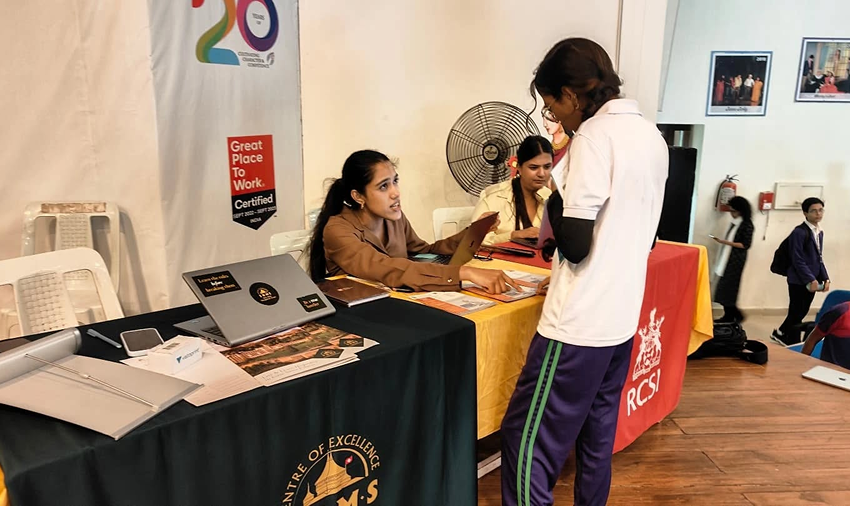
Planning for overseas university admissions should not begin in Class XII. An early start gives students more room to explore their interests and make informed academic choices. Students can focus on:
For families exploring international schools in Hyderabad, this broader approach to learning can be an important factor when comparing school environments.
Scores are rarely the problem. The gaps tend to appear elsewhere –
A school that understands international pathways will build these habits into your academic education rather than leaving you to improvise. Counselling, exam timelines, portfolio guidance and documentation support are all considerably easier when the school has done it before.
For families comparing the best CBSE schools in Hyderabad, it is not the identical syllabus, but the guidance wrapped around it.
At Glendale, we have spent two decades preparing students across CBSE, Cambridge and IB pathways, with established connections to universities worldwide. As part of the Global Schools Group, our students benefit from a network spanning 64 campuses across 11 countries. At Glendale, every academic milestone is a step towards a bigger world of possibilities.
Check our Class 10 and 12 results to trust us as your ideal choice and begin your CBSE admission today!

Key Takeaways:
|
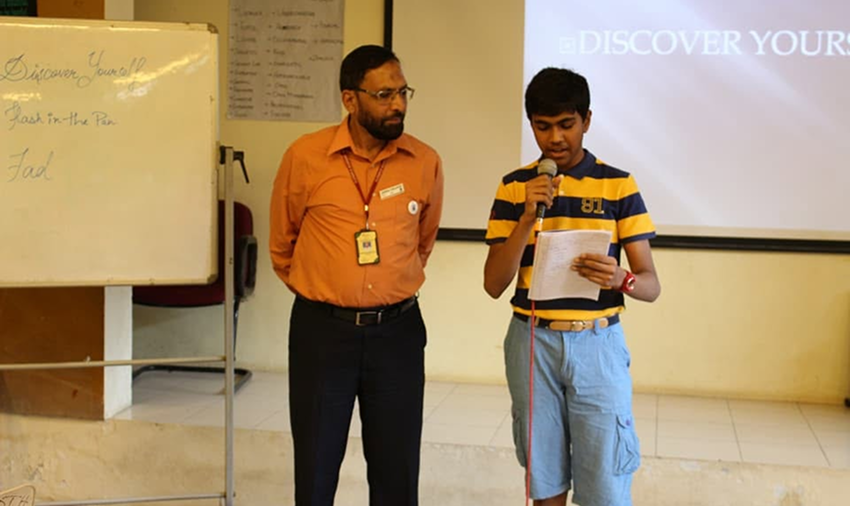
A decade from now, picture your child walking into a job interview where an algorithm has already done half the technical groundwork. What will set them apart? Not the answer they already know, but how they think, listen, and lead a room. That’s why leadership in schools has stopped being an extracurricular extra and has become the core of what a good education must deliver.
Artificial intelligence is already reshaping how work gets done across India, from IT services to banking and beyond. In education, in the age of AI, the skills that once guaranteed a good career, memorising formula or following instructions precisely, are exactly the skills machines now do faster. What remains distinctly human is the ability to lead a team, read a room and make a judgement call when the data alone does not have the answer.
According to the India Skills Report 2026, jointly published with the All India Council for Technical Education and the Association of Indian Universities, India’s national employability rate has climbed to 56.35 per cent, up from 54.81 per cent the previous year. The same report notes that India already holds 16 per cent of the world’s AI talent, a figure expected to touch 1.25 million professionals by 2027, and that over 90 per cent of employees across major sectors already use generative AI tools at work. The future with AI is not a distant scenario for India’s students. It is the environment they are set to graduate into.
|
Skill |
Why It Resists Automation |
|
Empathy |
Algorithms can process sentiment, but cannot build genuine trust |
|
Communication |
Persuading and reassuring people needs human nuance |
|
Decision-making under uncertainty |
Judgement outperforms prediction when data is incomplete |
|
Collaboration |
Teams that align around a shared goal still outperform isolated tools |
This is exactly why the importance of leadership skills keeps rising even as automation spreads. Employers are not only hiring for what a candidate knows. They are hiring for how a candidate thinks, adapts and works with others, none of which can be outsourced.
Developing student leadership in schools does not mean handing every child a badge or a title. It means building regular, low-stakes opportunities to practise decision-making, whether that is leading a small group project, resolving a disagreement with a classmate, or presenting an idea to peers. Repetition, not a single annual leadership camp, builds the habit.
Every child benefits from leadership skills for students, not just the naturally outspoken ones. Quieter children often develop strong listening and decision-making abilities when given structured opportunities to lead, while more assertive children learn restraint and collaboration. The goal is not to produce identical leaders, but confident communicators who can make sound decisions under pressure.
As one of the international schools in Hyderabad that treats leadership as a core academic outcome, Glendale weaves decision-making, communication and empathy into daily classroom practice, not just annual events. Our IB Primary Years pathway, in particular, is built around enquiry and reflection from the earliest grades, habits that carry directly into leadership later. If you are exploring school admissions in Hyderabad for a child who will grow up in an AI-driven world, this is the kind of foundation definitely worth exploring.
As classrooms adapt to a world shaped by AI, the schools that quietly get it right treat leadership as part of everyday learning rather than a separate subject. It is this consistency, built up over years rather than a single workshop, that helps children grow into confident, capable decision-makers.
We would love to show you what this looks like inside a Glendale classroom, whenever you are ready to take a closer look. Contact us to schedule an appointment or to learn more.