
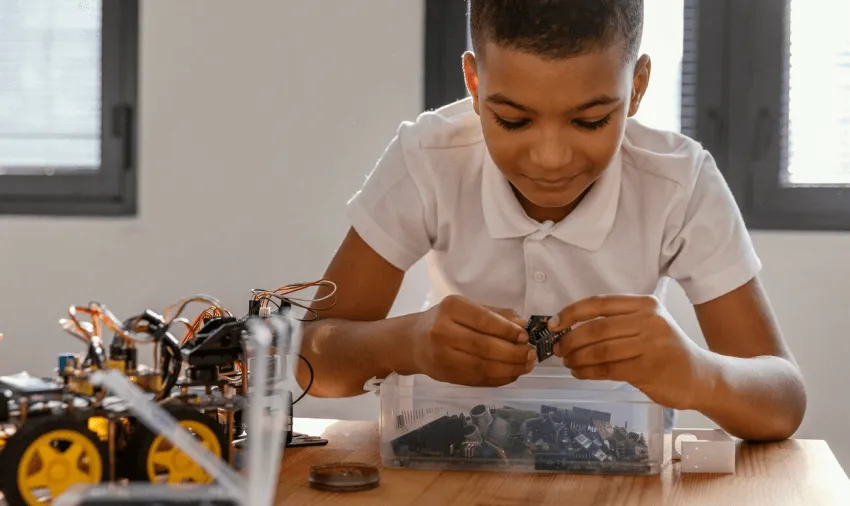
What Is STEM Education
STEM education is not a new concept in the educational framework but it is again gaining popularity for its ability to develop well-rounded individuals. Driven by technology and innovation, STEM education develops a strong foundational base for student’s learning and growth. Instead of rote memorisation, STEM equips students with essential skills, values, and knowledge to enjoy success in the innovative future.
Imagine a learning space where students’ imagination isn’t just limited to passive learning but encourages active participation! This is what STEM learning ensures by offering multiple benefits to help students thrive in the rapidly evolving world.
Introducing STEM concepts at an early learning age builds the foundation for the student’s academic and career success. Let us further explore the top benefits of introducing STEM in early childhood; are you excited?
Why Is STEM Education Important for Early Childhood Development?

Introducing STEM during the early years of learning encourages a lifelong love for learning while promoting essential skills. It provides a strong foundational base for the students to ensure their success in academics and beyond.
Among the various benefits of introducing STEM in early childhood, some of them are mentioned below:
How Does STEM Education Build a Strong Foundation for Lifelong Learning?
Children are naturally curious during their initial years of learning. Thus, the best CBSE schools in Hyderabad further encourage curiosity by introducing STEM to their students. This helps the students to gain a solid foundational vision for lifelong learning.
Students are encouraged to ask questions and concerns to foster a love for learning that grows throughout their lives. The early exposure to STEM cultivates an engaging mindset, making it easier for the students to embrace new learning. This not only helps them to achieve academic success but also to take life decisions by efficiently embracing the essential information.
How STEM Education Develops Critical Thinking and Problem-Solving Skills
In the present interconnected world, it is important for students to have critical thinking and problem-solving abilities. STEM empowers the students with essential skills through hands-on activities, experiments, and problem-solving activities. Students are given the understanding to analyse the challenging situation to think globally for developing relevant strategies.
These skills prove extremely helpful for their academic success and also in real-life situations. By cultivating critical thinking and problem-solving at a young age, students are prepared to efficiently navigate complex situations.

Unlock the Best Education with IB
How Does STEM Education Improve Academic Performance in Early Years?
The STEM program improves the academic performance of the students with its interdisciplinary nature. The students are rightly guided to make deeper connections between the various subjects, fostering a detailed understanding of the important concepts.
Additionally, the STEM educational framework relies on experiential and project-based learning to help students conceptualise their understanding. This helps students to implement and use their knowledge in real-world scenarios and challenges.
Why Is Collaborative Learning a Key Benefit of STEM Education?
The STEM activities usually involve teamwork using collaborative learning to encourage students to work together as a team. The collaborative approach helps students develop social skills, effective communication, and confidence to shine bright in any challenging situation.
Working in a group can further enhance language skills, making it easier to pick and understand new information. Collaborative learning also boosts empathy and cooperation among students to understand the importance of different perspectives in problem-solving.
How STEM Education Nurtures Creativity and Innovation in Young Learners
STEM education isn’t just about rote learning but it goes beyond the facts and figures, encouraging creativity and innovation. With hands-on activities, projects, and experiential learning, students are empowered to think creatively out of the box. Additionally, the students are supported and directed to find unique and innovative solutions to the challenges.
STEM provides complete freedom and flexibility to the students to explore and implement their ideas and vision for diverse problems. This enhances the confidence of the students to express themselves freely with their innovative and creative ideas and imagination.
How Early STEM Exposure Prepares Children for Future Careers
The integration of STEM in the early years of learning prepares students to utilise various career opportunities for their growth. Early exposure to STEM concepts helps students get a better understanding of their likes, interests, passions, and knowledge.
This helps the students to explore and decide the right career path for them, making a conscious decision. The early exposure also helps students develop the required skills needed to enter the competitive workforce.
Also Read: Making the Switch to the IGCSE Curriculum? Here’s Everything You Need to Know!
Why Early STEM Education Is Essential for a Child’s Future Success
Integrating STEM learning in the early years of learning is essential to nurture well-rounded individuals. It gives a strong foundation to the students, fostering curiosity, lifelong learning, and collaborative learning to shape their successful future. It can be rightly said that STEM empowers students to thrive in the globally connected world with their abilities and learning.
Glendale employs the Cambridge curriculum to benefit its students with a STEM educational approach by fostering critical thinking, creativity, and collaboration. By ensuring an active engagement with STEM, students are assured meaningful learning to see them as essential participants in the interconnected world. Choose Glendale and provide your child with an educational journey that prioritises innovation and creativity at an early age.